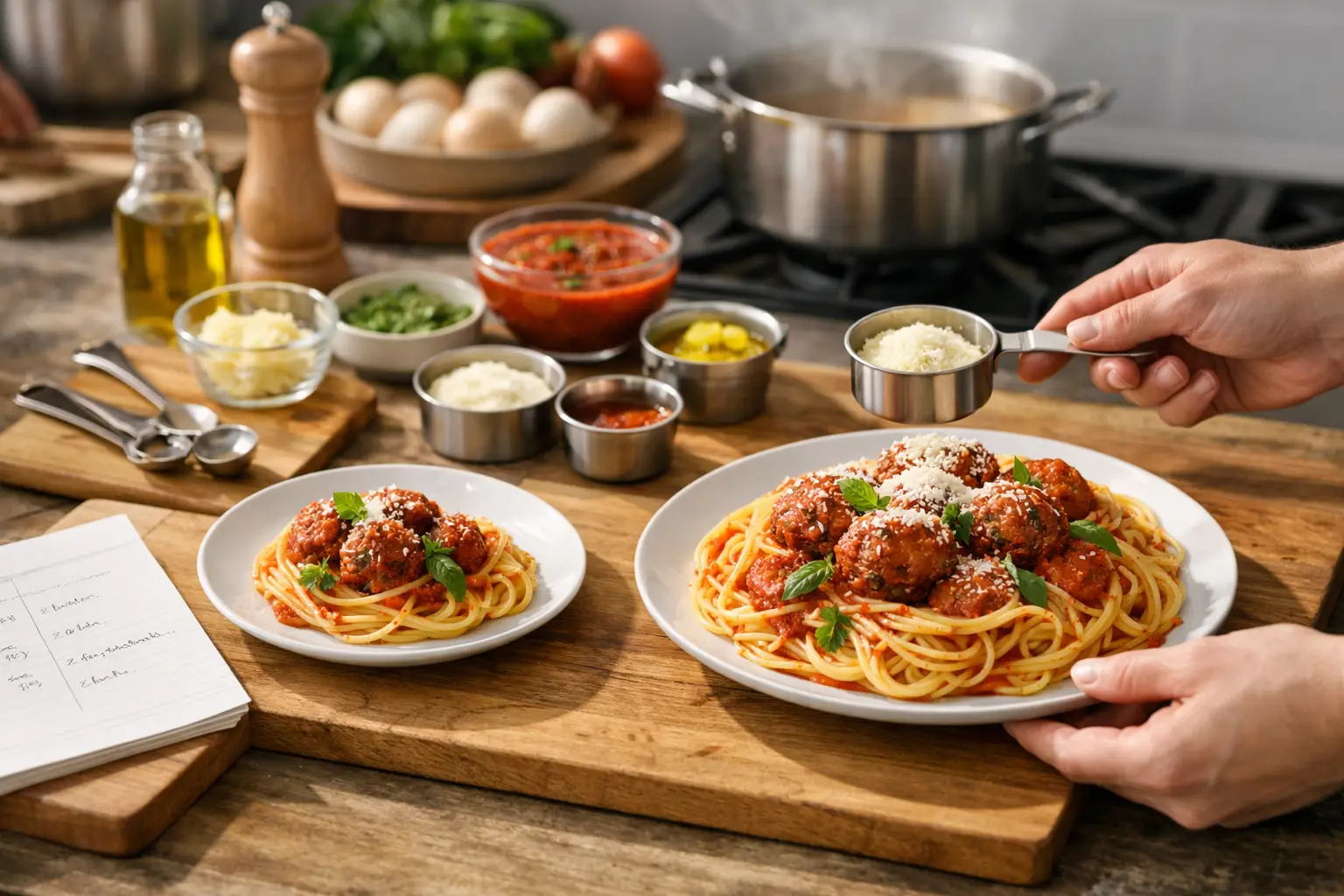
A recipe for four is great until two friends stay for dinner, your teenager brings a hungry teammate home, or you only need enough food for one. Knowing how to scale recipe servings means you can make the meal you want without guessing, wasting groceries, or ending up with a pasta sauce that feeds the whole building.
The basic maths is easy. The practical part takes a little more care. Ingredients do not all behave the same when doubled or halved, and a larger batch does not automatically cook in the same amount of time. Here is how to adjust recipes confidently, whether you are cooking for yourself, meal-prepping for the week, or feeding a busy household.
How to Scale Recipe Servings With a Multiplier
Start with the recipe's original yield and the number of servings you need. Divide your desired servings by the original servings to find your scaling multiplier.
Desired servings ÷ original servings = multiplier
If a recipe makes four servings and you need six, divide 6 by 4. Your multiplier is 1.5. Multiply every ingredient amount by 1.5. A recipe calling for 2 cups of rice becomes 3 cups; 500 g of chicken becomes 750 g.
If you are reducing that same four-serving recipe to two servings, divide 2 by 4. The multiplier is 0.5, so you halve each ingredient. This works for almost every recipe, from chili and stir-fries to muffins and overnight oats.
You do not always need perfectly exact numbers. If a soup needs 1.5 carrots, use one large carrot or two small ones. If a sauce calls for 1.5 cloves of garlic, one generous clove may be enough if you prefer a milder flavour. Scaling is meant to make dinner easier, not turn a weeknight meal into a maths exam.
Convert Measurements Before You Start Cooking
Recipes are simpler to scale when the measurements are in a format you can work with. For metric amounts, multiplication is usually straightforward: 300 g becomes 450 g when multiplied by 1.5. For cups and spoons, you may need a quick conversion.
For example, half of 3/4 cup is 3/8 cup. If you do not have a 3/8-cup measure, use 1/4 cup plus 2 tablespoons. Doubling 1/3 cup gives you 2/3 cup. Tripling 1/4 teaspoon gives you 3/4 teaspoon.
It helps to write the adjusted amounts beside the original recipe before you begin. This small step prevents the classic mid-recipe pause where you cannot remember whether you already doubled the broth or only meant to. For new cooks, measuring ingredients into separate bowls first can make the process even calmer.
When a recipe uses a whole item, such as one onion, one pepper, or one can of beans, think about size as well as quantity. Two small onions are not necessarily equal to two large onions. Use the listed ingredient as a guide, then adjust based on what is in your kitchen and how ingredient-forward you want the dish to be.
Which Ingredients Need a Lighter Touch?
Most main ingredients scale cleanly. Meat, vegetables, pasta, rice, beans, stock, and canned tomatoes can generally be multiplied by the same number. A few ingredients deserve a more gradual approach.
Salt, spice, and acidic ingredients
Salt, hot peppers, dried chilies, soy sauce, vinegar, lemon juice, mustard, and concentrated seasoning blends can become overpowering when multiplied exactly. When increasing a recipe, start with about three-quarters of the calculated amount for these ingredients. Taste near the end, then add more if needed.
This matters especially with recipes you have not made before. A teaspoon of chili flakes may be comfortable in four servings but feel much hotter in a doubled recipe because the flavours have more time and volume to concentrate together. The same goes for salt in a dish that will reduce as it simmers.
Fresh herbs are more flexible. You can usually scale them directly, although tender herbs such as basil, cilantro, parsley, and dill are often best added to taste just before serving. Their flavour and appearance are brighter that way.
Eggs and baking ingredients
Baking is less forgiving because the ingredient ratios affect structure. Doubling a muffin or cookie recipe is usually safe, but reducing it can get tricky when it calls for one egg. Beat the egg first, then measure out half by volume or weight. One large egg is roughly 3 tablespoons when beaten, so half is about 1 1/2 tablespoons.
Be cautious when scaling baking recipes beyond double or triple. A larger amount of batter may need a different pan, longer baking time, or separate batches. Leavening agents such as baking powder and baking soda should be measured carefully rather than rounded generously.
Your Pan Size Changes the Result
Scaling ingredients without considering your cookware is one of the fastest ways to create a frustrating dinner. A doubled stir-fry crowded into the same skillet will steam instead of brown. A larger pot of soup may take longer to reach a simmer. A baking dish that is too small can leave you with an overflowing casserole.
For stovetop recipes, use a wider pan or cook in batches when you increase the yield. Browning meat, mushrooms, or vegetables relies on enough surface area for moisture to evaporate. If your pan is packed, make two quick batches and combine everything before adding the sauce.
For baking, try to keep the batter depth similar to the original recipe. If you double a cake batter intended for one round pan, divide it between two similar pans rather than using one very deep pan. The temperature often stays the same, but the cooking time may change. Start checking at the original time, then continue checking in short intervals.
Do Not Double the Cooking Time
A larger recipe can take longer, but it rarely takes exactly twice as long. The extra time usually comes from heating a greater volume of food, not from a simple multiplication rule.
A doubled pot of soup may need several additional minutes to come to a simmer, then cook for roughly the same simmering time. A larger tray of roasted vegetables may take longer if it is crowded, but spreading them across two trays may actually keep the original timing close. Rotate trays halfway through if your oven has hot spots.
Use the recipe's visual and texture cues. Vegetables should be tender or browned as described. Pasta should be cooked to your preferred texture. Chicken, fish, eggs, and other foods should be cooked safely, using appropriate doneness guidance rather than relying only on the clock.
Scale for Leftovers on Purpose
Extra servings are useful when they fit your week. Making six portions of a curry for two people can cover another dinner, a packed lunch, or a freezer meal. But not every recipe keeps equally well. Crispy foods, delicate salads, and dishes with avocado or fresh herbs may be better made in smaller amounts.
Think about what you will realistically eat before scaling up. If you want a meal to stretch across several days, choose recipes that reheat well, such as soups, stews, grain bowls, pasta sauces, and baked dishes. Cool leftovers promptly, store them in portion-sized containers, and label them so they do not become a mystery item at the back of the fridge.
Scaling down can reduce waste too. If you are cooking for one, make the full recipe only when the leftovers have a plan. Otherwise, halve it and save the ingredients for another meal. A partial onion can go into tomorrow's omelette, while extra greens can become a quick lunch salad or smoothie ingredient.
Let Your Available Ingredients Set the Scale
Sometimes the serving size is not the starting point. Sometimes it is the ingredients you need to use. If you have 900 g of ground turkey and a recipe calls for 450 g for four servings, you already know you can double it for eight. Then check whether you have enough sauce, vegetables, and pantry staples to match.
This approach is especially handy before shopping. Build the recipe around the ingredient you have in abundance, then adjust the rest of the quantities. If you are short on one item, you may be able to replace it, add a complementary vegetable, or make a slightly smaller batch rather than buying a full package for a small amount.
When you want a tailored starting point, FlavorLab can generate a recipe around your serving size, available ingredients, cuisine preferences, dietary needs, and cooking time. That gives you a more useful first draft than resizing a recipe that was never designed for your evening.
The best scaled recipe is the one that suits your pan, your appetite, and the food already in your kitchen. Choose your servings, calculate the multiplier, season gradually, and let cooking cues guide the final timing. For your next flexible dinner plan, generate a recipe or turn what you already have into a meal with Pantry Rescue at FlavorLabApp.ca.